一、Product Application
The packer (bridge plug) testing equipment developed by Jinan SUPER Technology Co., Ltd. can complete all test contents for V5 level described in Clause 6.5.2.3 of API SPEC 11D1 (specific parameters and test procedures are shown in the Appendix). It can generate relevant test reports (pressure-time curves, etc.), serving as an important supporting document for applying for API V5 level product certification.
The equipment can apply setting pressure to the packer (bridge plug), impose upper and lower differential pressure on the sealing elements, provide axial unloading load, and meet the requirements for conveying test tools before and after the test.
The equipment consists of five parts: power system, medium circulation system, remote measurement and control system, axial load mechanism, and test platform.
二、Parameters of Packer (Bridge Plug) Testing Equipment
(I) Power System
The system includes motor, high-temperature pump, etc. The main technical parameters are as follows:
Test medium: Hydraulic oil
Test pressure range: 0–60 MPa
Flow rate:
Power:
Temperature range: Ambient temperature to 120 ℃
(II) Medium Circulation System
The system includes valves, pipelines, fittings, oil tank with heater, etc. The main technical parameters are as follows:
Temperature range: Ambient temperature to 120 ℃
Nominal diameter of pipeline:
Pipeline material:
Valve control mode: Automatic
Oil tank volume: 1 m³
Power of oil tank heater:
Oil tank material: Stainless steel
三、Features of Packer (Bridge Plug) Testing Equipment
The pressurizing equipment shall be intrinsically safe, equipped with overpressure automatic protection and pressure limiting functions. The whole system adopts dual operation modes: manual control and computer control, which operate independently without mutual interference.
The system design shall be forward-looking, ensuring that the increase in workload within 5 to 10 years after completion will not lead to major adjustments to the system. Meanwhile, considering domestic technical levels, the system design shall be based on saving test costs and equipment operation costs.
The whole system shall adopt an open architecture for easy expansion, enabling relatively independent subsystems to be easily combined and adjusted, in compliance with national or industrial standards.
参考网址: http://www.simingte.com/e_sfsmxhsyt.htm
shiyouhangyeshiyanji-sy
The high-pressure lost circulation control tester is mainly used to simulate formation temperature, pressure and other conditions, record leakage time, leakage volume, and the leakage state of the simulated leakage zone, and statically evaluate the leakage control effect of drilling mud.
Through leakage tests, the different leakage behaviors of various formations are studied, providing complete and effective scientific basis for preventing lost circulation in drilling engineering and correctly handling lost circulation accidents.

The downhole tool test device is a special unit designed to meet the testing requirements of coiled tubing downhole tools under high temperature and high pressure conditions.
It takes a high-power variable-frequency motor-driven plunger pump and three sets of tool testing instruments as the core, and adopts PLC for system control.
The device is mainly divided into two parts:
Coiled Tubing Downhole Tool Test Bench
Circulation System for Simulating Downhole High-Temperature Environment up to 300℃
Testing is carried out by manual tool loading and unloading, automatic clamping, hydraulic propulsion, etc., so as to evaluate the operating parameters and maintenance status of the tools.
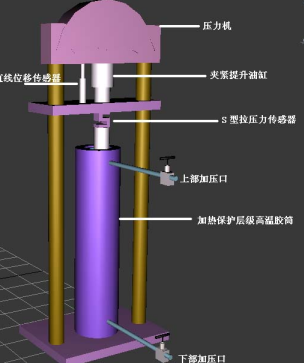
The gravel packing sand control morphology simulation test device is used to highly simulate downhole extrusion packing operation conditions, study the morphology of gravel under different processes, provide further reference for construction technology, and analyze the influence of longitudinal heterogeneity of unconsolidated sandstone reservoirs on the extrusion packing morphology of gravel layers.
Based on the experimental results, it provides an operational basis for the construction scheme and product optimization of gravel packing operations in sand control wells under different conditions.

|