I. Product Introduction
The steering system durability and fatigue testing machine, independently developed by Jinan SUPER Technology Co., Ltd., is designed to conduct durability tests on steering wheels and power steering pumps respectively.
The test method for steering wheel durability complies with QC/T 563-2014 Technical Requirements and Test Methods for Automobile Steering Wheels;
The test method for power steering pump durability complies with QC/T 299.1-2014 Automotive Hydraulic Power Steering Pumps – Part 1: Technical Requirements.
II. Technical Parameters of Steering System Durability & Fatigue Testing Machine
No-load Pressure P₀: 0.5 MPa (subject to actual product)
Max Pressure Pmax: 13–13.7 MPa (subject to actual product)
Controlled Flow Rate: 13±1 L/min (subject to actual product)
Minimum Rotational Speed nmin: 500 r/min (subject to actual product)
Maximum Rotational Speed nmax: 3500 r/min (subject to actual product)
Air Pressure Range: 0–800 kPa
Measurement Accuracy of Air & Hydraulic Pressure Sensors: 0.5%
Force Measurement Accuracy: 1%
Power Supply: 380 V, 50 Hz
Display Mode: Touch screen display
Max Durability Cycles: 999,999
Test Station Quantity: 1 station
Rotational Angle: 1080° adjustable
III. Test Methods of Steering System Durability & Fatigue Testing Machine
Mount the steering wheel, telescopic steering shaft assembly, power steering gear and load on the steering wheel fixture in vehicle-mounted state. Install the power steering pump and steering oil reservoir on the flow test bench as fitted on real vehicles.
A motor drives the power steering pump to provide rotational speed, and an air cylinder drives the steering wheel to rotate three full turns in each direction. This test bench completes full steering system durability tests and supports performance research of the entire steering assembly.
Constant-Speed Impact Durability Test for Power Steering Pump
Install the power steering pump in simulated vehicle mounting state. A motor drives the pump at a set speed of 1500 r/min. Pressure cycles between no-load pressure P₀ and maximum pressure Pmax at a frequency of 2 Hz. The test waveform is shown in Figure 4, with a total of 500,000 impact cycles.
Oil temperature, hydraulic pressure, flow rate and output torque of steering gear shall be monitored throughout the test.
Pressure Gradient: 100 MPa/s
Oil Temperature: (80±5) °C
After test completion, compared with pre-test status:
Allowable pressure drop ≤ 10%
Allowable flow rate variation ≤ 10%
No structural damage is permitted

qicheshiyanji-q
The hydrogen refueling nozzle air tightness testing machine is mainly used for air tightness performance and static hydraulic strength tests of hydrogen refueling receptacles and hydrogen refueling nozzles of automotive fuel cells.
This tester complies with national standards: GB/T 34425 Fuel cell electric vehicles — Hydrogen refueling nozzles, GB/T 26779-2021 Fuel cell electric vehicles — Hydrogen refueling receptacles, and GB/T 31138-2022.
In accordance with test items, required test pressure and duration, each test function is divided into independent functional modules. Adopting a modular design, the equipment utilization rate is maximized to improve inspection efficiency.
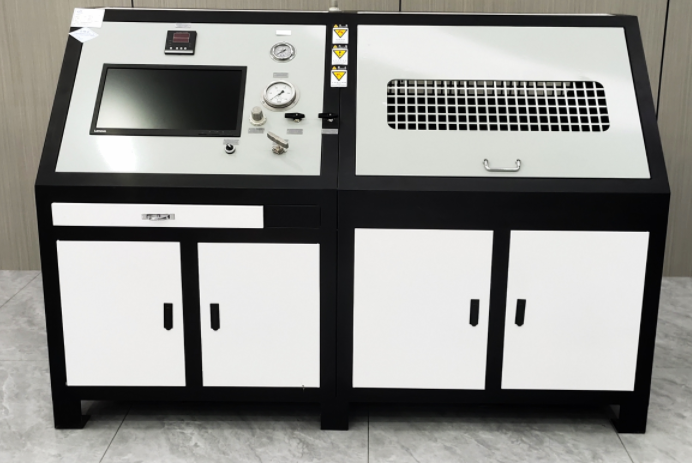
Chip Cold Plate Burst Pressure Test Bench is mainly applied for pressure resistance and burst tests of heat dissipation cold plates and chips.
The equipment is equipped with an automatic control system software to realize automatic pressure control and adjustment, as well as a supporting data acquisition system.
This machine can export test reports in Excel format and store all test data.

The PTC heater performance test bench developed by Jinan SUPER Technology Co., Ltd. is mainly used for heat exchange performance testing of PTC heaters.
It can test the flow resistance (power characteristics) of PTC heaters and measure their thermal performance to obtain the thermal characteristic curves of PTC components. Besides, it supports characteristic analysis of the relationship between flow rate and head of electronic water pumps.

|