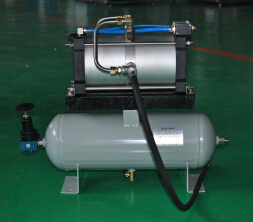
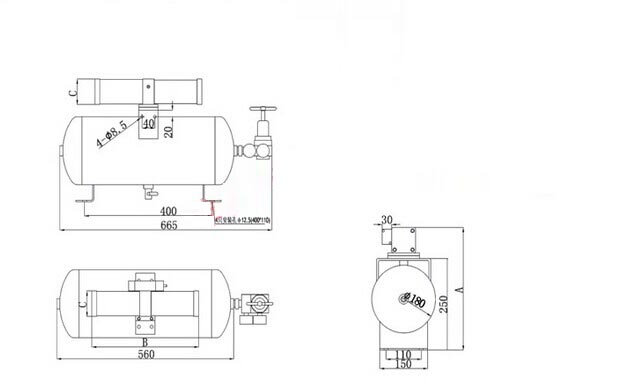
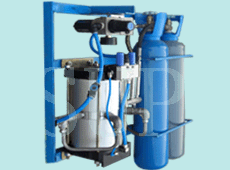
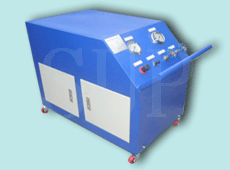
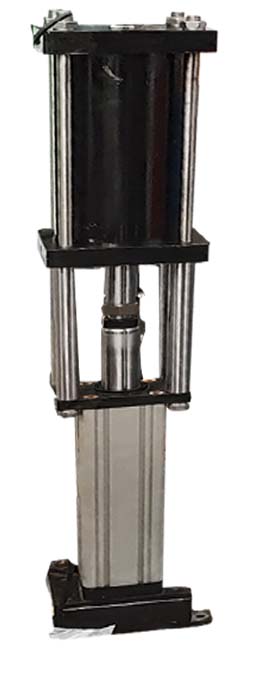
SUPER compressed air booster pumps are applied in working environments where the existing air compressor system requires pressure elevation. They can boost the air pressure of the working system to 2 to 5 times the original value, with only the compressed air from the existing system serving as the driving gas source. This pump is suitable for single air source pressurization.
Maximum working pressure: 40 bar
Flow rate: 1,350 L/min (standard state)
No extra energy consumption once the preset pressure is achieved.
No power supply required (applicable to explosion-proof areas).
Model |
SUP_W |
Boost Ratio |
2:1、5:1 |
Drive Pressure (bar) |
1-8 |
Drive Port Size |
3/4' |
Outlet Port Size |
1/2' |
Inlet Port Size |
1/2' |
Working Principle of Super Compressed Air Booster Pump
(1) The compressed air booster pump realizes pressure boosting by using a large-area cylinder to push a small-area cylinder. The large-area part is the drive cylinder for driving air, with a diameter of 160 mm. Pressure amplification is achieved via the area ratio. The drive gas pressure ranges from 0.1 to 0.8 MPa based on Pascal’s Principle:
Drive Cylinder Area × Drive Pressure = Output Gas Pressure × Boost Cylinder Area
Features of SUPER Compressed Air Booster Pump
Portable
No electric power required
Cost-effective
Maintenance-free lubrication
Lightweight
Single-acting & double-acting types available
Advantages of SUPER Compressed Air Booster Pump
Stepless adjustable pressure; no compressed air consumption during pressure holding.
Automatic pressure stabilization and pressure retention once the target pressure is reached.
Compact and lightweight: small models weigh 3 kg, large models 18 kg.
Driven by compressed air or nitrogen; no electric sparks generated, suitable for explosion-proof environments.
Buffer tank can be equipped as required.
Able to start under loaded pressure.
Related Products:
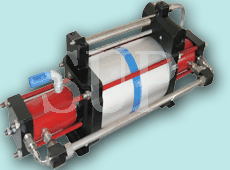
This is a two-stage booster pump capable of raising extremely low-pressure gas to ultra-high pressure. The driving air pressure is ≤7 bar, and the inlet gas pressure ranges from 0.5 to 10 bar, with a maximum output pressure up to 90 MPa, ideal for high-pressure gas boosting applications.
Powered by compressed air, the pump features explosion-proof performance. It can boost various gases including nitrogen, hydrogen, air and helium. The pressure is steplessly adjustable. No energy is consumed during pressure holding, and the pump is equipped with an integrated cooling device.
For more details, click: Pressure Booster Pump
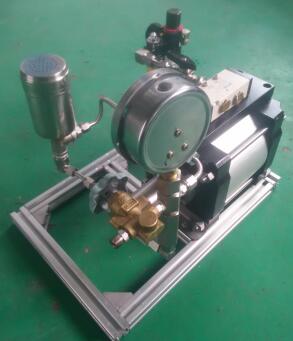
The chromatography column packing equipment independently developed by Jinan SUPER Technology Co., Ltd. is equipped with Simte pneumatic booster pumps, with a driving air pressure range of 0.2~0.7 MPa.
This test equipment is specially designed for wet packing of high-performance liquid chromatography columns. It features rapid pressure rise, high working pressure, low back pressure and portable design. With a simple structure, it facilitates convenient packing and disassembly of chromatographic columns as well as easy maintenance. The machine adopts an aluminum profile frame and supports adjustable output pressure. Driven by compressed air, it achieves precise pressure control and output by adjusting the driving air pressure.
For more details, click: Chromatography Column Packing Equipment
zengyabeng-m
The servo high-pressure pump is a multi-functional product with wide adaptability. It can pressurize air, nitrogen, helium, clean water, hydraulic oil and other media to meet high-pressure gas application requirements in various industries. It can convey various media including water and industrial liquids, and adapt to different temperature, flow and pressure ranges.
Typical Applications:
Industrial Pressurization: High-precision pressure injection systems
University Research: High-precision pressure test devices, rock test equipment
Laboratories: High-precision pressure testing systems
For more details, click: Servo High-Pressure Pump

Conversion Relationships of Pressure Units: MPa, kPa, bar, psi
Compressibility Relationship Between Water Pressure and Air Pressure
Differences Between Hydrostatic Test and Pneumatic Test
|