I. Application Scope:
The flameproof lamp airtightness testing machine developed by Jinan SUPER can perform both airtightness and hydrostatic pressure tests on flameproof lamps. The test pressure ranges from 1 to 2 MPa. After the target pressure is set, the machine automatically stops pressurization. Equipped with a built-in stainless steel water tank, it allows real-time observation of bubbles to assess the airtightness and pressure resistance of the flameproof lamp under hydrostatic conditions. Additionally, it features a flameproof observation window to ensure the safety of testing personnel.
  
II. Equipment Composition
-
The flameproof lamp testing device is equipped with a Jinan Simingte booster pump, offering adjustable pressure up to 2 MPa.
-
A booster unit is included, providing stepless pressure adjustment within its specified range.
-
A transparent explosion-proof observation window is installed to maximize personnel safety.
III. Equipment Features
-
Equipped with a control device, allowing easy adjustment and regulation of output pressure and time.
-
Advanced technology with a rational structural design. Drive air pressure: 0.2-0.8 MPa. Air consumption: 0.3-1 cubic meter/min.
-
Can be equipped with an automatic data acquisition system to monitor pressure curves, print reports, and save pressure test data to Excel spreadsheets for future reference.
IV. Technical Parameters
-
Data Recording: Manual recording or computer-based recording options are available.
-
Pressure: 2 MPa, adjustable within a certain range.
-
Air Consumption: 0.3-1 cubic meter/min.
-
Working Medium: Air.
-
Data acquisition systems can be configured according to customer requirements.
V. Model Selection
Product Name |
Explosion-proof Lamp Housing Airtightness Testing Machine |
Product Model |
SUP_GBD_Y2 |
Basic Principles |
Powered by ordinary compressed air, the system utilizes a Simingte booster pump to pressurize the gas to a high pressure level. The airtightness of the flameproof lamp housing is then observed to determine whether any leakage occurs. |
Performance Parameters |
Test Pressure |
0~1.5MPa(压力可选) |
Pressure Control Accuracy |
+2% of the upper limit of the test pressure value, -1% of the lower limit |
Pressure Value Resolution |
0.1MPa |
Pressure Sensor |
Test Pressure Sampling Frequency: 1 Second |
Test Medium |
Air |
Operation Method |
Manual Control, Computer Control |
Time Control |
Automatic Pressure Retention, Automatic Pressure Release Upon Test Completion (Optional) |
Sample Installation Method |
Threaded Connection |
Scope of Application |
Coal Mine Explosion-Proof Lamp Housing, Tunnel Lamp Housing |
Related Products
The pneumatic quick connector leak detector developed and produced by Jinan SUPER is used for leak testing of quick connectors. It allows for setting holding pressure, stabilization time, pressure retention time, and pressure drop. It is designed for leak testing and pressure testing of products under evaluation.
For more information, please visit:Pneumatic Quick Connector Leak Detector

The internally ignited non-propagation test bench equipment developed by Jinan SUPER is computer-controlled and complies with the reference standard: GB 3836.2-2010 Explosive Atmospheres—Part 2: Equipment Protection by Flameproof Enclosures, Section 15.2: Internally Ignited Non-Propagation Test. It is used to examine whether external gases are ignited or exploded after an internal ignition occurs within the tested enclosure.
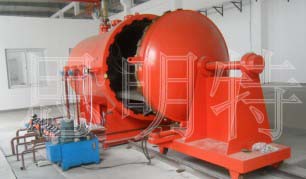
Click for details:Internally Ignited Non-Propagation Test
Related Products
The hydraulic pressure tester is primarily used for pressure strength testing of various pressure pipelines, pressure vessels, and instrumentation. It utilizes a pressure gauge to indicate the pressure resistance value, providing accurate and reliable results with simple and convenient operation—all without the need for an external power supply. The tester features a compact structure, aesthetically pleasing design, intuitive operation and display, and occupies minimal space.


压力单位的换算关系MPa,kPa,bar,psi
Relationship Between Compressibility of Hydraulic Pressure and Pneumatic Pressure
Difference Between Hydrostatic Testing and Pneumatic Testing
|